

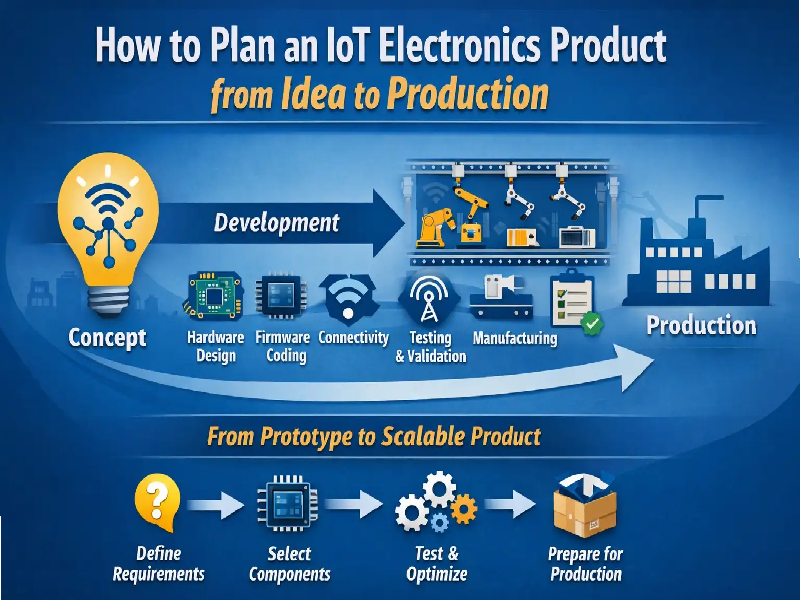
Building an IoT electronics product means making dozens of technical decisions that directly affect cost, reliability, and scalability. This guide explains how to plan an IoT electronics product from idea to production, covering hardware, firmware, connectivity, testing, and manufacturing—so teams avoid rework, delays, and failed launches.
Why IoT Electronics Products Fail Without Proper Planning
- Most IoT electronics failures don’t come from bad ideas
- Poor planning between concept and production causes late-stage problems
- Early shortcuts turn into redesign, delays, and cost overruns
- Teams underestimate real-world and production constraints
Define the Real Problem Your IoT Product Solves
Every strong IoT electronics product starts with a clearly defined problem, not a feature list. Without this clarity, design decisions lose direction and teams struggle to align hardware, firmware, and system behavior with real user needs.
Questions That Must Be Answered Early
- What decision or action will this device enable?
- Who will use it and in what environment?
- What happens if the device fails or goes offline?
Identify Functional and Non-Functional Requirements
IoT electronics planning must clearly separate what the device does from how reliably it must do it. This distinction prevents under-designing critical systems that later cause failures in production or the field.
Requirement Categories That Shape Design
- Functional requirements like sensing, control, and communication
- Non-functional requirements like power, durability, security, and lifespan
- Ignoring non-functional needs leads to redesign later
Make Early Architecture Decisions That Scale
Architecture choices lock in long-term outcomes in IoT electronics. Changing processors, connectivity, or system topology later is expensive and risky once firmware and hardware are tightly coupled.
Architecture Decisions With Long-Term Impact
- MCU vs MPU affects performance and power consumption
- Connectivity type affects deployment cost and reliability
- Edge vs cloud processing affects latency and bandwidth usage
Select Components With Production Reality in Mind
Component selection is where many IoT electronics products quietly fail. A prototype may work with convenient parts, but production demands long-term availability and stable sourcing.
Component Planning Risks to Watch For
- Limited lifecycle or end-of-life components
- Single-source dependency
- No alternate parts planned
Design Hardware for Manufacturing, Not Just Function
A working PCB is not the same as a manufacturable PCB. Production introduces constraints around assembly, yield, testing, and repeatability that prototypes rarely expose.
Manufacturing-Focused Design Considerations
- Component spacing affects yield and rework
- Panelization impacts assembly efficiency
- Test points enable faster validation
Plan Firmware as a Lifecycle, Not a One-Time Build
Firmware planning is often underestimated in IoT electronics. Production devices must remain secure, updateable, and maintainable for years, not just function on day one.
Firmware Planning Requirements
- Over-the-air update capability
- Memory allocation for future features
- Security designed for real-world threats
Choose Connectivity Based on Total Cost, Not Convenience
Connectivity is one of the most expensive long-term decisions in IoT electronics. The easiest option for prototyping may become the most costly at scale.
Connectivity Trade-Offs to Evaluate
- Cellular simplifies deployment but adds recurring costs
- LPWAN reduces power usage but limits bandwidth
- Wi-Fi depends heavily on deployment conditions
Power Planning Is a System-Level Decision
Power design is not just about battery size. It defines how the entire IoT electronics system behaves over time, especially in the field.
Power-Related Planning Factors
- Duty cycles impact battery life more than component choice
- Sleep strategies must be validated in real conditions
- Charging and protection circuits add complexity
Validation and Testing Must Reflect Real Usage
Lab testing alone is not enough. IoT electronics products behave differently under environmental stress, interference, and long-term operation.
Testing Areas That Reveal Hidden Failures
- Environmental and thermal testing
- Connectivity stress testing
- Long-duration power and memory tests
Compliance and Certification Planning Cannot Be Delayed
Regulatory requirements influence both hardware and firmware design. Late compliance failures often force costly redesigns.
Compliance Areas That Affect Design
- RF approvals affecting antenna and layout
- Safety standards impacting power design
- Regional regulations influencing component choices
Manufacturing Readiness Is More Than Volume Scaling
Production readiness is about consistency, yield, and quality control—not just producing more units.
Manufacturing Readiness Requirements
- Clear and repeatable assembly instructions
- Reliable test procedures
- Documentation that supports scale
Common Trade-Offs in IoT Electronics Planning
There is no perfect IoT electronics design—only informed trade-offs that must be made consciously and early.
Typical Trade-Off Areas
- Performance vs power consumption
- Cost vs long-term reliability
- Flexibility vs system complexity
Real-World Constraints Teams Often Underestimate
Experienced teams plan for constraints that rarely appear in early prototypes but dominate real deployments.
Frequently Overlooked Constraints
- Component shortages and substitutions
- Field servicing limitations
- Unpredictable user behavior
When Early Planning Is Not Enough
Some IoT electronics challenges only appear after deployment. Planning should allow for correction, not assume perfection.
Post-Deployment Reality Checks
- Firmware updates may require redesign support
- Scaling may expose connectivity limits
- Regulatory changes may force updates
How to Know If Your IoT Electronics Plan Is Strong
A strong plan answers difficult questions before production begins and reduces uncertainty later.
Questions a Strong Plan Can Answer
- Can this design scale without redesign?
- Are long-term costs predictable?
- Can failures be handled remotely?
Final Thought
Planning an IoT electronics product from idea to production is not about slowing development. It is about building something that survives real-world use, scales predictably, and avoids expensive corrections later.