

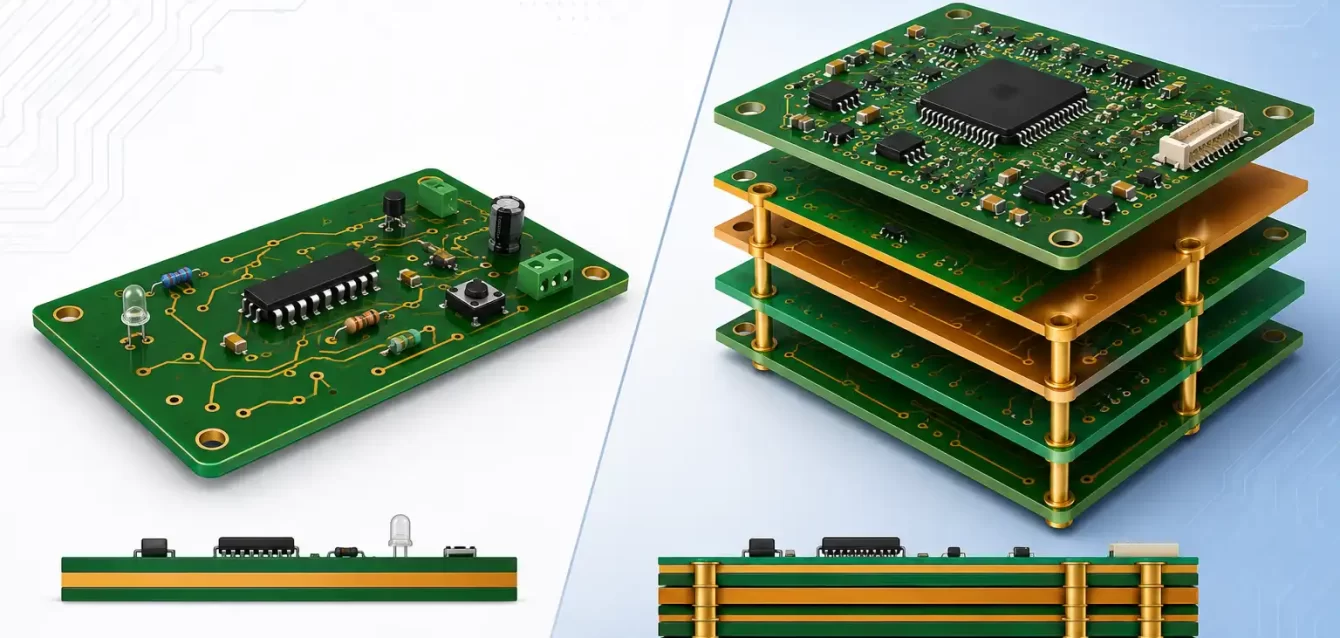
Choosing between a single-layer PCB and a multilayer vs Single-Layer PCB depends on your product’s complexity, electrical performance, manufacturing requirements, and future scalability. Single-layer PCBs are suitable for simple, low-cost electronics, while multilayer PCBs are designed for compact, high-performance products that require better signal integrity, power distribution, and reliability.
This guide explains when each PCB type is appropriate, the trade-offs involved, and how to make the right engineering decision before starting PCB layout.
This guide explains when each PCB type is appropriate, the trade-offs involved, and how to make the right engineering decision before starting PCB layout. Understanding the distinctions between multilayer vs Single-Layer PCB can greatly influence your design process.
Why This Decision Matters
When considering multilayer vs Single-Layer PCB options, it’s crucial to evaluate your project’s specific needs.
Selecting the wrong PCB layer count can increase manufacturing costs, delay development, and require expensive redesigns. Although reducing layers may seem like a cost-saving decision, it often creates routing challenges, signal integrity issues, and production limitations later in the project.
Common consequences include:
- PCB routing becomes difficult as component density increases.
- Signal noise affects circuit performance.
- Additional prototype revisions increase development time.
- Manufacturing costs rise due to repeated board redesigns.
- Future product upgrades become difficult.
What Is a Single-Layer PCB?
A single-layer PCB contains one conductive copper layer where all electronic components and traces are placed. Since routing is available on only one side, these boards are best suited for simple electronic products with minimal circuit complexity.
Single-layer PCBs are commonly used when:
- Component count is relatively low.
- Circuit routing is straightforward.
- High-speed communication is not required.
- Product cost is a major consideration.
- Manufacturing simplicity is preferred.
Typical applications include:
The choice of multilayer vs Single-Layer PCB can impact your product’s performance and cost-effectiveness.
- LED lighting circuits
- Power supply boards
- Relay control circuits
- Educational development boards
- Basic sensor modules
While these boards are economical, limited routing space often restricts future expansion.
What Is a Multilayer PCB?
A multilayer PCB consists of multiple copper layers laminated together with insulating material. Internal layers are typically dedicated to power and ground, improving electrical performance and allowing more complex routing.
Evaluating multilayer vs Single-Layer PCB structures can lead to significant improvements in design flexibility.
Multilayer PCBs are generally selected when products require higher performance, compact layouts, or advanced electronic functionality.
They are commonly used for:
- Industrial automation systems
- IoT devices
- Medical electronics
- Embedded computing platforms
- Automotive control systems
- Communication equipment
Although manufacturing costs are higher, multilayer boards significantly improve reliability and long-term product performance.
Single-Layer vs Multilayer PCB Comparison
Both PCB types solve different engineering problems. The right choice depends on product requirements rather than simply minimizing manufacturing cost.
| Feature | Single-Layer PCB | Multilayer PCB |
|---|---|---|
| Cost | Lower | Higher |
| Routing Space | Limited | Extensive |
| Signal Integrity | Basic | Excellent |
| EMI Performance | Lower | Better |
| Board Size | Larger | More Compact |
| Manufacturing Complexity | Low | High |
| Component Density | Low | High |
| Product Scalability | Limited | Excellent |
How to Decide Which PCB You Need
Rather than choosing based only on budget, evaluate your complete product requirements before deciding on the PCB structure.
Consider the following questions:
- How many components are included?
- Does the circuit contain high-speed interfaces?
- Is board size restricted?
- Are EMI requirements important?
- Will the product move into volume manufacturing?
- Are future hardware revisions expected?
Choosing between multilayer vs Single-Layer PCB is essential for achieving desired product functionality.
In many cases, the multilayer vs Single-Layer PCB debate comes down to specific application requirements.
Answering these questions early reduces redesign risk later.
Engineering Factors That Influence Layer Count
PCB layer count affects much more than routing. It directly influences electrical performance, manufacturability, thermal behavior, and long-term reliability.
Important engineering considerations include:
Signal Integrity
High-speed signals require continuous reference planes to minimize reflections and maintain impedance.
Key considerations:
- USB
- Ethernet
- DDR memory
- High-speed SPI
- PCIe interfaces
The decision of multilayer vs Single-Layer PCB affects everything from cost to performance.
These applications generally benefit from multilayer designs.
Power Distribution
Dedicated power planes reduce voltage drop and improve current distribution across the PCB.
Benefits include:
- Stable power delivery
- Reduced electrical noise
- Better decoupling effectiveness
- Improved overall circuit stability
Multilayer vs Single-Layer PCB: Key Differences
EMI and EMC Performance
Products operating in noisy electrical environments often require multilayer stackups to reduce electromagnetic interference.
Multilayer boards help by:
- Providing continuous ground planes
- Reducing radiation
- Improving return current paths
- Supporting regulatory compliance
Common Mistakes Engineers Make
Many PCB redesigns result from incorrect layer count decisions made early in development.
Frequently observed mistakes include:
- Selecting single-layer boards for dense circuits.
- Ignoring future product expansion.
- Underestimating routing complexity.
- Prioritizing PCB cost over development cost.
- Delaying DFM reviews until layout completion.
These decisions often increase prototype iterations and delay product launch.
Real-World Applications
Different industries have different PCB requirements depending on operating conditions and performance expectations.
Examples include:
Consumer Electronics
Usually require:
- Compact designs
- Wireless connectivity
- High component density
Multilayer PCBs are commonly preferred.
Industrial Automation
Products must withstand electrical noise and continuous operation.
Typical requirements include:
- Robust grounding
- Reliable communication
- High current capability
Medical Devices
Medical electronics demand consistent electrical performance and compact packaging.
Design priorities include:
- Low signal noise
- High reliability
- Accurate sensor measurements
LED Lighting
Most LED driver circuits remain relatively simple.
Single-layer PCBs are often sufficient because:
- Routing requirements are minimal.
- Manufacturing costs remain low.
- Maintenance is easier.
When a Multilayer PCB Is Worth the Investment
Although multilayer boards cost more initially, they often reduce overall development costs by preventing design limitations.
A multilayer PCB becomes worthwhile when:
- High-speed communication is required.
- Product size must remain compact.
- Multiple power rails are present.
- EMI performance is critical.
- Manufacturing reliability is important.
- Long product life is expected.
Looking only at fabrication cost often overlooks these long-term benefits.
Decision Checklist
Before finalizing your PCB stack-up, review the following checklist.
Choose a Single-Layer PCB if:
- Circuit complexity is low.
- Product budget is highly constrained.
- Routing is simple.
- High-speed signals are absent.
- Future expansion is unlikely.
Choose a Multilayer PCB if:
- Component density is high.
- Product size is limited.
- Signal integrity is important.
- EMI reduction is required.
- Production scalability is planned.
Frequently Asked Questions
Is a single-layer PCB cheaper?
Yes. Single-layer PCBs generally have lower fabrication costs because they use fewer materials and involve simpler manufacturing processes. However, they may increase overall development costs if routing limitations require multiple redesigns.
Does every modern electronic product require a multilayer PCB?
No. Many simple products continue to use single-layer or double-layer PCBs successfully. Multilayer boards become necessary when electrical performance, routing density, or compact packaging demand additional layers.
How many PCB layers are enough?
There is no universal answer. The appropriate layer count depends on signal speed, component density, power distribution, EMI requirements, thermal performance, and manufacturing goals.
Can changing layer count improve reliability?
Yes. Additional layers often provide better grounding, cleaner power delivery, and improved signal routing, all of which contribute to more reliable electronic products.
Key Takeaways
Selecting the correct PCB structure influences every stage of product development, from layout and manufacturing to long-term reliability.
Key points to remember:
- Single-layer PCBs work well for simple electronic products.
- Multilayer PCBs support higher performance and greater routing density.
- Layer count should be based on engineering requirements, not only manufacturing cost.
- Early PCB planning reduces redesigns and production delays.
- Considering future scalability often prevents expensive hardware revisions.
Conclusion
Choosing between a single-layer PCB and a multilayer PCB is an engineering decision that balances performance, manufacturability, cost, and long-term product goals. While single-layer designs remain suitable for simple applications, modern connected devices increasingly require the routing flexibility, signal integrity, and reliability that multilayer PCBs provide.
Evaluating your product’s electrical requirements, mechanical constraints, and production objectives early in the design process helps reduce risk, minimize redesigns, and create a PCB that supports both prototype development and future manufacturing.
Ultimately, the multilayer vs Single-Layer PCB choice will shape your product’s entire lifecycle.
By understanding multilayer vs Single-Layer PCB options, you can make informed decisions that align with your project goals.
In summary, the multilayer vs Single-Layer PCB decision is one that should not be taken lightly; it requires careful consideration of various factors.