

Why Engineers Are Re-Thinking Embedded Design Today
Can microcontrollers run machine learning reliably without cloud dependency or high power consumption? That question is now shaping modern embedded system architecture decisions across industries.
This article explains how TinyML differs from traditional embedded design, where each approach succeeds or fails, and how engineers should decide between them based on real-world constraints—not theory.
You will learn:
- What fundamentally changes when ML moves onto microcontrollers
- Architectural and engineering trade-offs
- Practical deployment realities
- When TinyML is the right choice — and when it is not
The Core Problem: Traditional Embedded Systems Are Reaching Limits
Traditional embedded design works well for deterministic control tasks. But modern devices now require intelligence, prediction, and context awareness — capabilities classical firmware struggles to deliver efficiently.
Engineers increasingly face systems that must interpret data locally rather than simply execute logic.
Common limitations appearing today:
- Rule-based firmware becomes complex and hard to maintain
- Cloud dependency increases latency and security risk
- Continuous sensor data overwhelms deterministic logic models
- Power budgets restrict always-connected architectures
- Real-time decisions cannot rely on remote processing
Traditional embedded systems were designed for control, not learning.
What TinyML Actually Changes in Embedded Systems
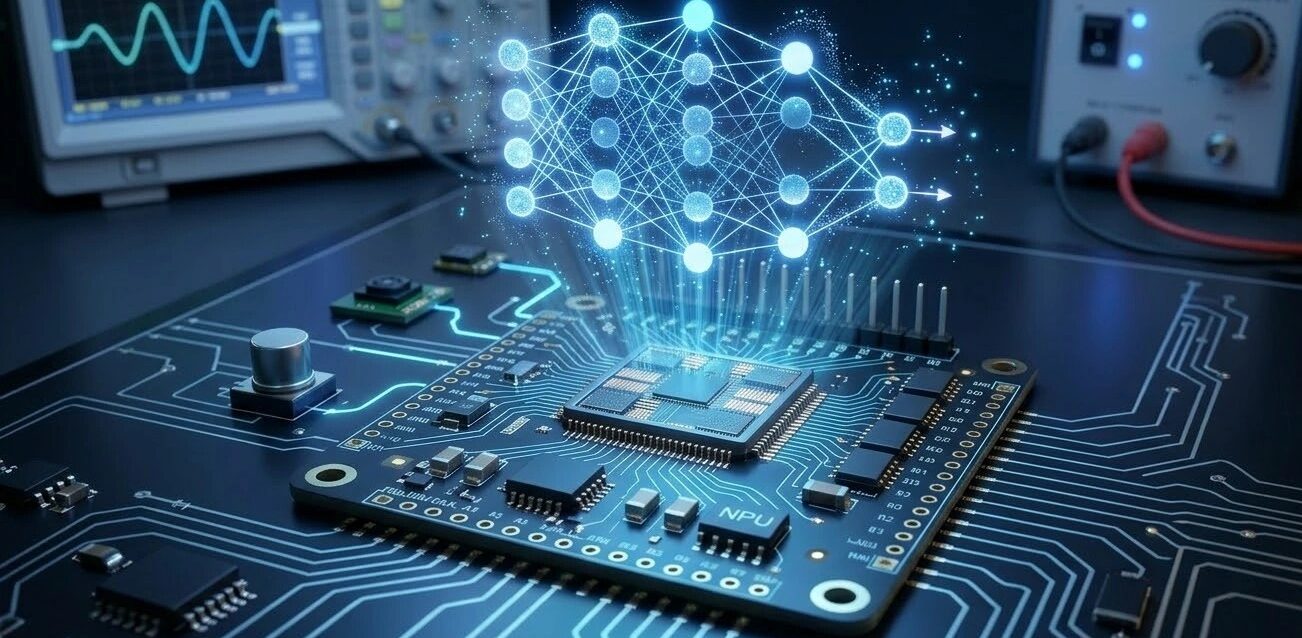
TinyML moves machine learning inference directly onto microcontrollers, enabling devices to interpret patterns locally without external computation.
This is not simply adding AI — it fundamentally changes system design philosophy.
Key technical shifts introduced by TinyML:
- Models replace rule-based decision trees
- Sensor interpretation becomes probabilistic instead of deterministic
- Edge processing reduces communication requirements
- Firmware integrates ML inference pipelines
- Memory and compute optimization become primary design constraints
Instead of programming every condition, engineers train systems to recognize behavior.
Traditional Embedded Design: How It Works in Practice
Traditional embedded systems follow predictable input-output logic. Sensors provide signals, firmware evaluates conditions, and outputs trigger actions.
This model remains extremely reliable for structured environments.
Typical characteristics:
- Deterministic firmware execution
- Fixed algorithms and thresholds
- Minimal runtime variability
- Predictable debugging workflows
- Low computational overhead
Where it excels:
- Motor control systems
- Industrial automation
- Safety-critical control loops
- Power management controllers
- Communication protocols
The strength of traditional design is certainty.
TinyML Design: A Different Engineering Model
TinyML introduces inference engines operating within tight resource limits—often kilobytes of RAM and milliwatts of power.
Engineering effort shifts from writing logic to optimizing models.
Design characteristics:
- Neural network inference on-device
- Quantized models (INT8 or smaller)
- Feature extraction pipelines
- Dataset-driven behavior tuning
- Continuous model validation
New engineering responsibilities:
- Data collection strategy
- Model compression
- Memory mapping optimization
- Hardware acceleration usage
- Accuracy vs latency balancing
The challenge moves from coding complexity to model efficiency.
Architecture Comparison: TinyML vs Traditional Embedded Design
Both approaches solve problems differently because they operate under different assumptions.
Traditional Embedded Architecture
- Logic defined during development
- Behavior predictable and fixed
- Minimal runtime adaptation
- Low memory usage
- Debugging via firmware tracing
TinyML Architecture
- Behavior learned from datasets
- Adaptive decision-making
- Runtime probabilistic outputs
- Higher memory pressure
- Debugging includes data analysis
The difference is not incremental — it is architectural.
Power Consumption: The Hidden Decision Factor
Many assume machine learning increases power usage. In practice, TinyML often reduces total system energy when designed correctly.
Local inference removes continuous wireless transmission — one of the largest power drains.
Traditional approach power costs:
- Constant sensor polling
- Frequent data transmission
- Cloud processing dependency
- Radio usage spikes
TinyML power advantages:
- Event-based processing
- Reduced communication cycles
- Sleep-heavy operation models
- Intelligent wake detection
Energy savings come from doing less communication, not cheaper computation.
Memory and Hardware Constraints Engineers Must Manage
TinyML systems operate under extreme constraints compared to cloud AI environments.
Microcontrollers were not originally designed for ML workloads, forcing careful optimization.
Real design constraints include:
- RAM often below 512 KB
- Flash storage limitations
- Model size compression requirements
- Quantization accuracy loss
- Real-time inference deadlines
Engineers frequently trade model accuracy for deployability.
A model that works perfectly on a workstation may fail entirely on embedded hardware.
Development Workflow Differences
The engineering workflow changes significantly when adopting TinyML.
Traditional embedded development focuses on firmware iteration, while TinyML adds a data lifecycle.
Traditional workflow:
- Requirements → Firmware → Testing → Deployment
TinyML workflow:
- Data collection
- Model training
- Optimization
- Firmware integration
- Field validation
- Continuous refinement
This introduces cross-disciplinary collaboration between embedded and data engineers.
Debugging and Validation Challenges
Debugging TinyML systems differs fundamentally from traditional debugging.
Failures are often statistical rather than logical.
Traditional debugging:
- Trace execution path
- Identify logic error
- Fix firmware
TinyML debugging:
- Analyze misclassification cases
- Evaluate dataset bias
- Adjust model architecture
- Retrain and redeploy
Engineers must accept that ML systems rarely achieve deterministic perfection.
Real-World Impact on Product Design
TinyML enables capabilities previously impractical for low-power devices.
Products increasingly require local intelligence for usability and efficiency.
Where TinyML creates measurable impact:
- Predictive maintenance sensors
- Voice-triggered devices
- Anomaly detection systems
- Smart wearables
- Industrial monitoring nodes
The value appears when systems must interpret patterns rather than thresholds.
Risks and Limitations Engineers Should Consider
TinyML is not universally superior. Many deployments fail because teams adopt it without clear necessity.
Understanding limitations prevents costly redesign cycles.
Common risks:
- Insufficient training data quality
- Overestimating model accuracy
- Hardware resource exhaustion
- Increased development complexity
- Maintenance overhead for retraining
TinyML introduces intelligence but also operational responsibility.
When Traditional Embedded Design Is Still the Better Choice
Deterministic systems remain essential in many environments.
If a problem can be solved with fixed logic reliably, ML may add unnecessary risk.
Traditional design is better when:
- Behavior is clearly defined
- Safety certification is required
- Decisions must be fully explainable
- Power budgets are extremely constrained
- Data variability is low
Predictability remains a critical engineering requirement.
When TinyML Becomes the Right Engineering Decision
TinyML shines when systems must interpret complex real-world signals locally.
It is particularly valuable when connectivity is limited or latency matters.
TinyML is ideal when:
- Pattern recognition is required
- Continuous sensing generates large datasets
- Cloud dependency is undesirable
- Devices must operate offline
- Adaptive behavior improves performance
The decision should follow problem complexity, not technology trends.
Decision Framework Engineers Can Use
Choosing between TinyML and traditional embedded design should follow structured evaluation.
Ask these questions first:
- Is rule-based logic becoming unmanageable?
- Does the system require pattern recognition?
- Is latency critical?
- Can training data be collected reliably?
- Are hardware resources sufficient?
If most answers are yes, TinyML becomes viable.
Key Takeaways Engineers Should Remember
- Traditional embedded design delivers predictability and reliability.
- TinyML introduces adaptive intelligence at the edge.
- Power savings often come from reduced communication.
- Development workflows become data-driven.
- Debugging shifts from logic analysis to statistical validation.
- TinyML increases capability but also complexity.
- Not every embedded problem requires machine learning.
Why This Knowledge Matters Going Forward
Embedded systems are transitioning from controllers to intelligent agents operating at the edge. Engineers who understand when to apply TinyML versus traditional design will build systems that scale efficiently instead of becoming overly complex or underpowered.
The future of microcontrollers is not replacing traditional embedded engineering — it is expanding it. The strongest designs will combine deterministic control with localized intelligence, choosing the right tool for the right constraint.