

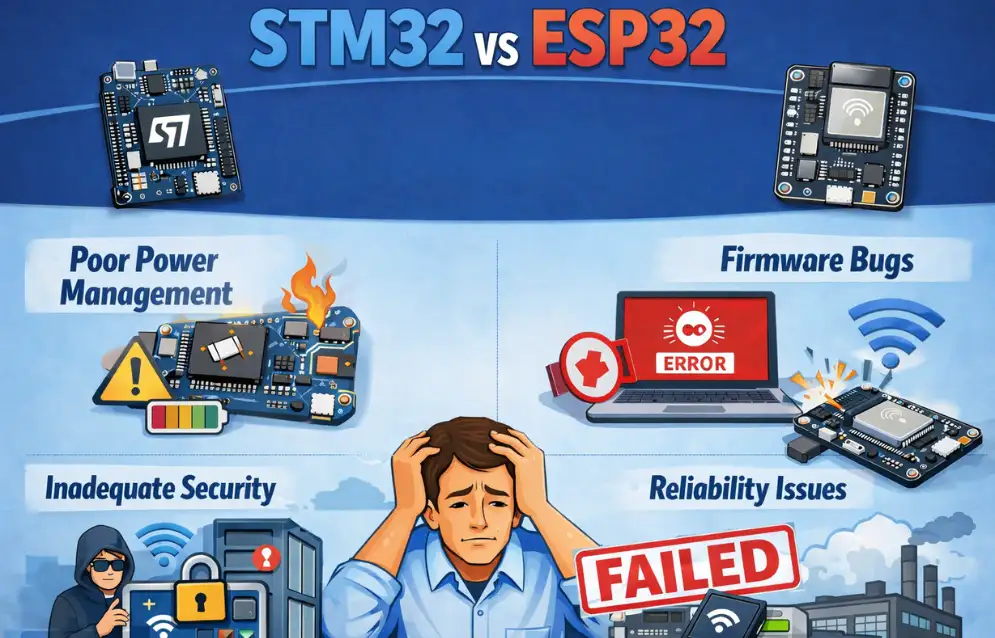
Most IoT product failures don’t come from bad ideas or poor execution. They come from early microcontroller decisions, especially when teams choose between STM32 vs ESP32 without fully understanding real-world constraints.
This article explains where teams go wrong, why those mistakes happen, and how to avoid costly redesigns, field failures, and scaling issues.
Key Takeaways
- STM32 vs ESP32 failures usually come from misaligned use cases, not weak hardware
- Prototypes hide power, timing, and reliability issues that appear in production
- Connectivity convenience often trades off control, predictability, and battery life
- Firmware architecture and lifecycle planning matter as much as MCU features
- Choosing the right MCU is about risk management, not popularity or specs
The Core Problem With STM32 vs ESP32 Decisions
Most teams treat MCU selection as a feature comparison. That’s the mistake.
- Wi-Fi and Bluetooth are prioritized over power budgets
- Development speed is valued over long-term stability
- Bench testing is mistaken for field validation
- MCU choice is locked before system requirements are finalized
STM32 vs ESP32 decisions fail when constraints are discovered after hardware is frozen.
Why This Matters More in Modern IoT Products
IoT expectations have changed. What worked five years ago now breaks products.
- Battery-powered devices are expected to last years, not months
- Connectivity failures are no longer acceptable edge cases
- Security flaws have legal and financial consequences
- Hardware redesigns are slower and more expensive
The wrong MCU choice doesn’t just slow development—it threatens product viability.
How STM32 and ESP32 Are Fundamentally Different
STM32 and ESP32 are often compared directly, but they are built for different priorities.
- STM32 focuses on deterministic behavior, power efficiency, and lifecycle stability
- ESP32 focuses on integrated connectivity and fast time-to-market
Problems arise when teams assume both can serve the same role with minor trade-offs.
Mistake 1: Using ESP32 in Power-Critical IoT Products
ESP32 is frequently chosen because connectivity is built in. That convenience hides risk.
- Active power consumption is significantly higher
- Wireless stacks introduce unpredictable wake behavior
- Background tasks reduce control over sleep cycles
In battery-powered devices, these issues compound quickly.
What happens in the field
- Battery life falls far below estimates
- Devices require frequent maintenance
- Customer confidence erodes after deployment
Mistake 2: Avoiding STM32 Because Wireless Feels “Hard”
STM32 is often dismissed early due to perceived complexity.
- External radios seem harder to integrate
- Middleware configuration feels slow
- Tooling appears more rigid
This avoidance often leads to worse outcomes.
Why this assumption fails
- External radios allow precise power control
- Wireless failures can be isolated from core logic
- Firmware becomes easier to reason about at scale
STM32 forces architectural discipline that many products need.
Mistake 3: Treating Prototypes as Proof of Production Readiness
A working prototype answers only one question: does it run?
- Stable lab Wi-Fi hides real-world interference
- USB power masks battery drain issues
- Debug builds hide timing and memory problems
ESP32 prototypes especially give a false sense of security.
Production consequences
- Random resets appear after deployment
- Timing bugs surface under load
- Debugging becomes slow and expensive
Mistake 4: Ignoring Firmware Architecture Constraints
MCU choice also determines how firmware behaves over time.
- ESP32 relies heavily on large software frameworks
- Task scheduling can become unpredictable
- Memory fragmentation is harder to control
STM32 requires more upfront structure but offers tighter control.
The real trade-off
- Faster development vs long-term predictability
- Flexibility vs determinism
Ignoring this leads to firmware that becomes fragile as features grow.
Mistake 5: Underestimating Security Complexity
Security is often discussed late, after hardware decisions are fixed.
- ESP32 security depends on correct configuration
- OTA mechanisms expand attack surfaces
- Key management errors affect entire fleets
STM32-based designs often integrate security more explicitly.
Why this matters
- Post-deployment vulnerabilities are hard to fix
- Compliance issues surface late
- Security flaws often require hardware changes
Mistake 6: Ignoring Lifecycle and Supply Stability
IoT products live longer than consumer electronics.
- ESP32 variants evolve quickly
- Long-term pin and part stability varies
- Ecosystem changes can break builds
STM32 families prioritize long-term availability.
Impact on products
- Unexpected redesigns
- Re-certification costs
- Manufacturing delays
Lifecycle planning is part of MCU selection, not an afterthought.
How These Mistakes Appear in Real Deployments
Across real-world IoT deployments, patterns repeat.
- ESP32 devices fail battery-life targets
- STM32 projects stall due to rushed architecture
- Wireless assumptions break in industrial or rural areas
- Late-stage redesigns become unavoidable
These are not edge cases—they are common failure modes.
How MCU Mistakes Escalate Over Time
Early MCU decisions compound quietly.
- Temporary workarounds become permanent
- Firmware complexity increases
- Debug time multiplies
- Hardware limitations surface too late
By the time problems are obvious, fixing them costs significantly more.
STM32 vs ESP32: Where Each Actually Works Best
Failure comes from misuse, not from choosing the “wrong” MCU universally.
ESP32 works best when
- Continuous connectivity is required
- Power is available or rechargeable
- Rapid iteration is the priority
STM32 works best when
- Battery life is critical
- Timing and control must be deterministic
- Products must remain stable for years
Problems occur when these boundaries are ignored.
A Practical Way to Choose Without Overthinking
Instead of comparing features, assess risk.
- If connectivity convenience defines the product → ESP32
- If long-term stability defines the product → STM32
- If failures are tolerable → ESP32
- If failures are costly → STM32
This reframes MCU selection as a risk decision, not a spec comparison.
Final Takeaways
- STM32 vs ESP32 failures are usually architectural, not technical
- Prototypes hide the problems that appear at scale
- Power, security, and lifecycle planning matter more than features
- Firmware structure determines long-term reliability
- Early MCU decisions define whether products survive real-world conditions
Closing Thought
IoT products rarely fail suddenly. They fail slowly, as early microcontroller decisions collide with real-world constraints. STM32 vs ESP32 is not about which MCU is better—it’s about which risks you can afford.
Make that decision deliberately, before hardware locks you into problems you can’t easily fix.