

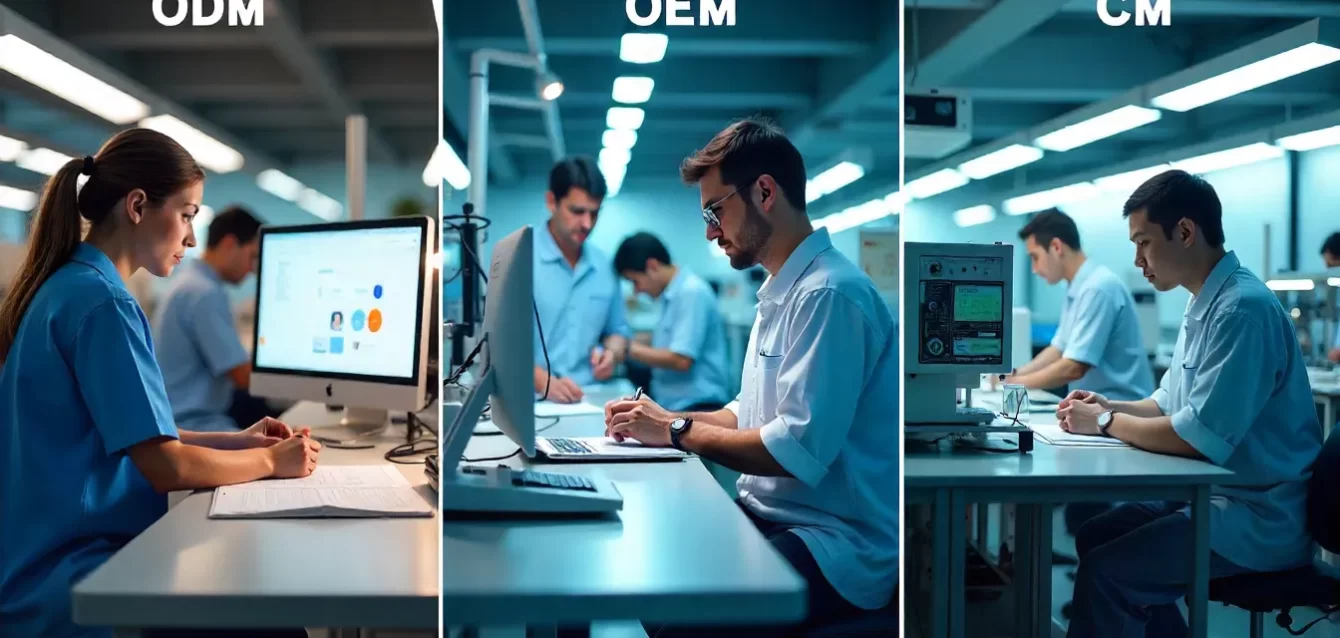
If you’re trying to decide between ODM, OEM, and CM for your next hardware, electronics, or product development project, the smartest approach is to first understand what each model actually offers — and which one aligns with your goals, budget, and timeline.
Most businesses choose the wrong manufacturing partner simply because they don’t understand the difference. But when you pick the right model, you get:
- Faster development
- Lower cost
- Higher quality
- Clean IP ownership
- Better control over your product lifecycle
In this guide, you’ll learn:
- What ODM, OEM, and CM really mean — in simple words
- The biggest differences between the three
- Which model you should pick based on your product stage
- Real-world use cases for each
- How to select the right manufacturer for your needs
- Trends shaping modern manufacturing in 2025
Let’s break it down clearly — and help you choose the right partner from idea to launch.
1. Why Choosing the Right Manufacturing Model Matters
Whether you’re building a consumer gadget, IoT device, electronic product, smart wearable, medical device, or industrial hardware, your manufacturing model determines:
- Your cost structure
- Your intellectual property (IP) ownership
- Your design control
- Your ability to scale
- Your product quality
- Your time-to-market
Choosing the wrong option can trap you in delays, higher costs, and dependency on a manufacturer.
Choosing the right one makes your product journey smoother, predictable, and scalable.
Below is the clearest explanation you’ll find online — written for fast understanding and decision-making.
2. Understanding ODM, OEM & CM — Simple & Clear Definitions
2.1 What Is ODM (Original Design Manufacturer)?
An ODM designs and develops the product for you.
You simply select, customize, brand it, and launch it.
ODM is best when:
- You want a product fast
- You don’t want to design from scratch
- You want low cost and faster time-to-market
- You don’t have an internal engineering team
Example:
A startup wants to launch a smart home device quickly.
They choose an ODM, customize the enclosure and UI, add branding, and go to market in 3 months.
Why ODM stands out:
- Lowest cost
- Fastest development
- Good for non-technical teams
2.2 What Is OEM (Original Equipment Manufacturer)?
In an OEM model, you design it, and the manufacturer simply builds it.
OEM is best when:
- You want full design control
- You have engineers or product designers
- IP ownership is important
- You’re building a unique, custom product
Example:
A company designing a medical wearable uses its internal design team but sends the schematic + PCB design to an OEM who handles manufacturing.
Why OEM stands out:
- Full control
- High quality
- Clean IP ownership
2.3 What Is CM (Contract Manufacturer)?
A Contract Manufacturer does not design your product.
They handle production, assembly, testing, supply chain, and scaling.
CM is best when:
- You already have a finished design
- You need high-quality mass production
- You want strong supply-chain support
- You want competitive pricing
Example:
A robotics company completes its hardware design internally, then uses a CM for 10,000+ unit production.
Why CM stands out:
- Excellent for scaling
- High-volume efficiency
- Strong component sourcing
3. ODM vs OEM vs CM — What’s the Real Difference?
| Feature | ODM | OEM | CM |
|---|---|---|---|
| Who designs the product? | Manufacturer | You | You |
| Cost | Low | Medium | Medium/High |
| Speed | Fast | Moderate | High once designed |
| IP Ownership | Shared/Limited | Full | Full |
| Best for | Startups, fast launches | Custom products | Scaling and mass production |
4. Which Model Should You Choose? (Immediate Answer)
If you want the fastest answer possible:
✔ Choose ODM if:
You want a ready-made product that you can customize and launch fast.
✔ Choose OEM if:
You want a fully custom product with full control and own the IP.
✔ Choose CM if:
You already have a finished design and now need high-quality manufacturing.
That’s the core — but let’s go deeper for clarity and confidence.
5. Real-World Scenarios: When Each Model Makes Sense
5.1 Choose ODM When:
- You have limited engineering resources
- You want to enter the market quickly
- Cost is a major factor
- Your product doesn’t need heavy customization
Example:
A fitness brand wants a smart band. ODM provides a standard design → brand → launch in 8–10 weeks.
5.2 Choose OEM When:
- You’re building something technologically unique
- You want complete control over design
- You want long-term scalability with your own IP
- Your industry requires compliance (medical, aerospace, industrial)
Example:
A MedTech company requires CE/FDA compliance → OEM ensures custom design with proper standards.
5.3 Choose CM When:
- You already finalized the design (electrical + mechanical)
- You want mass production at the lowest unit cost
- You need supply chain, testing, and lifecycle support
Example:
A drone company needs 50,000 PCB assemblies per year → CM ensures consistent quality + scale.
6. Key Factors to Consider Before Choosing ODM, OEM, or CM
To avoid costly mistakes, check these essential factors:
6.1 Technical Expertise
A reliable manufacturer should offer:
- PCB assembly
- SMT & through-hole manufacturing
- Box build & system integration
- Advanced electronics testing
- Ability to handle IoT, embedded, industrial, or medical products
A strong technical partner = fewer delays + faster launch.
6.2 Quality & Compliance
For long-term reliability, ensure they follow:
- ISO 9001
- ISO 13485 for medical devices
- IPC standards
- RoHS & CE compliance
Good manufacturers invest heavily in testing, rework control, and process quality.
6.3 Production Flexibility
Your partner must support:
- Prototyping
- Small-batch runs
- Medium & high-volume production
- Quick-turn manufacturing
Flexibility is essential, especially for startups and early-stage products.
6.4 Supply Chain & Component Sourcing
A great manufacturer offers:
- Strong supplier relationships
- Active component availability checking
- Alternatives for obsolete parts
- Cost optimization
- Risk mitigation
Supply-chain strength directly impacts product success.
6.5 End-to-End Support
Choose a partner who can help you through the entire lifecycle:
- Design validation
- DFM/DFT improvements
- Prototyping
- Manufacturing
- Testing
- Packaging
- After-sales support
This reduces friction and ensures smooth scaling.
7. Trends Shaping Manufacturing in 2025
7.1 AI in Product Design & Manufacturing
AI is now influencing:
- PCB routing
- Thermal optimization
- Component placement
- Predictive maintenance
- Automated testing
Faster design, fewer errors.
7.2 Automation & Smart Factories
Robots and automated SMT lines provide:
- Consistent quality
- Faster production
- Lower unit cost
- Reduced defects
This is now standard among top manufacturers.
7.3 Sustainable Manufacturing
Leading manufacturers adopt:
- Lead-free solder
- Eco-friendly materials
- Energy-saving systems
- Waste reduction processes
Global clients now demand green manufacturing.
7.4 Miniaturization & Advanced Electronics
Modern products need:
- Smaller PCBs
- High-density layouts
- Micro components
- Lightweight enclosures
Manufacturers with advanced machinery excel here.
8. How to Choose the Right Manufacturing Partner (Step-by-Step)
Follow this simple process:
Step 1: Define Your Goals
Include:
- Product concept
- Customization level
- Target market
- Budget
- Volume requirements
Step 2: Match Your Needs to the Right Model
- Low customization → ODM
- High customization & IP → OEM
- High volume manufacturing → CM
Step 3: Evaluate Capabilities
Check their:
- Factory quality
- Certifications
- Testing capability
- Engineering support
Step 4: Request a Prototype or Pilot Batch
This reveals:
- Actual quality
- Communication speed
- Problem-solving ability
Step 5: Negotiate Clear Terms
Discuss:
- Delivery schedules
- Unit pricing
- IP rights
- Warranty
- Long-term scalability
Step 6: Scale with Confidence
Once you are confident, move to medium or high-volume production.
Final Thoughts: ODM vs OEM vs CM — What’s the Best Choice?
The best manufacturing model depends on your product stage, complexity, and business goals.
Quick summary:
✔ ODM → Fastest & cheapest
✔ OEM → Full control & custom design
✔ CM → Best for mass production
Each model has clear strengths — the key is choosing what aligns with your product vision.
Next Steps
- Define your product goals clearly
- Choose the model that fits your stage (ODM/OEM/CM)
- Evaluate manufacturers for quality, expertise, and scalability
- Start with a prototype to validate reliability
Your idea deserves the right manufacturing partner — one that helps you move from idea to launch smoothly.