

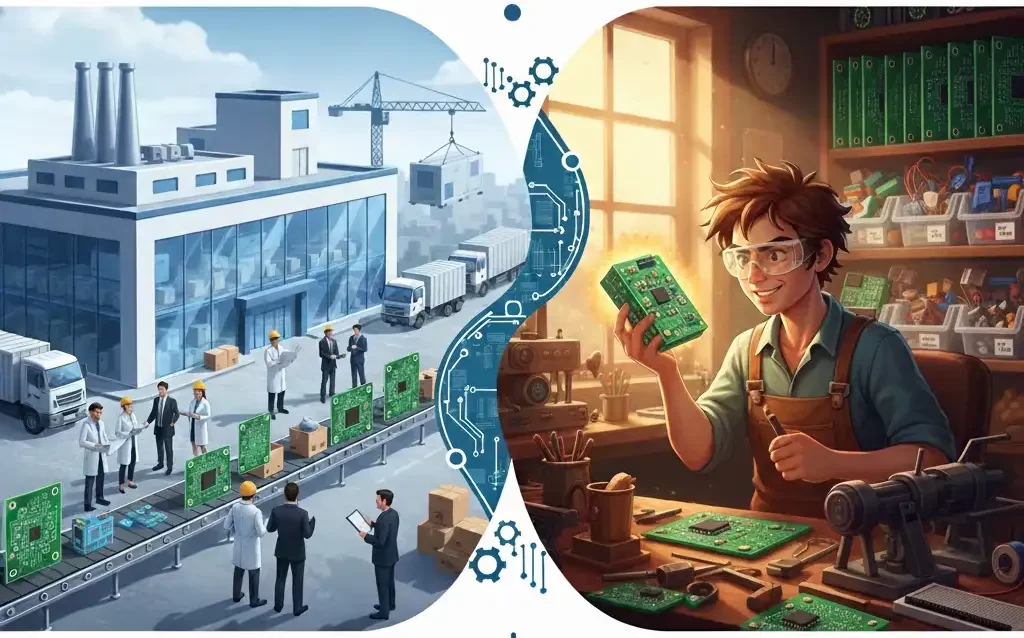
Contract manufacturing and in-house production represent two fundamentally different approaches to turning a product idea into a market-ready solution. The right choice depends on cost structure, speed to market, control, scalability, and long-term business strategy. Contract manufacturing offers flexibility and faster execution by leveraging external expertise, while in-house manufacturing provides deeper control and ownership over production processes.
This topic is important because today’s product-driven businesses—especially in electronics, hardware, medical devices, and industrial systems—face intense pressure to launch faster, control costs, and scale without failure. Manufacturing decisions are no longer operational details; they directly impact competitiveness, reliability, and profitability. This article explains how both models work, where each one fits best, and how to choose the right approach so readers get clear, practical answers quickly.
Why Manufacturing Choice Is a Critical Business Decision
Manufacturing strategy affects far more than just how a product is built. It influences cash flow, timelines, quality consistency, risk exposure, and the ability to respond to market demand. A poor decision at this stage can delay launches, inflate costs, or limit scalability just when demand increases.
Many businesses struggle because they make manufacturing decisions too early or based on assumptions rather than real constraints. Some invest heavily in in-house production before demand is proven, while others outsource without understanding the trade-offs involved. Choosing the right model early helps avoid redesigns, operational stress, and costly pivots later.
Key Risks of Choosing the Wrong Manufacturing Model
- Higher-than-expected production costs
- Delayed product launches
- Quality and reliability issues
- Limited scalability during growth
- Increased operational and financial risk
What Is Contract Manufacturing?
Contract manufacturing involves outsourcing the production of your product to a specialized third-party manufacturer. You retain ownership of the design, intellectual property, and brand, while the manufacturer handles fabrication, assembly, testing, and sometimes sourcing.
This approach allows businesses to focus on product development, marketing, and customers instead of building and managing manufacturing infrastructure. It is widely used across electronics, medical devices, automotive systems, and consumer hardware.
Core Characteristics of Contract Manufacturing
- Production handled by an external specialist
- Lower upfront capital investment
- Variable, volume-based cost structure
- Faster production ramp-up
- Access to established processes and expertise
Why Businesses Choose Contract Manufacturing
Contract manufacturing is often chosen when speed, flexibility, and cost control are more important than total production ownership. It reduces the burden of managing factories, equipment, and large teams, especially during early stages.
For many products, especially new or evolving ones, this model reduces risk while enabling faster market entry.
Benefits of Contract Manufacturing
- Faster time to market
- Reduced upfront investment
- Easier scaling up or down
- Access to skilled labor and proven workflows
- Lower operational complexity
What Is In-House Manufacturing?
In-house manufacturing means producing your product entirely within your own facilities using your own workforce, equipment, and systems. This model gives you direct control over every aspect of production, from process optimization to quality assurance.
While this approach offers strategic advantages, it also requires significant investment and operational maturity. It is typically adopted once production volumes are stable and processes are well understood.
Core Characteristics of In-House Manufacturing
- Full control over production processes
- High fixed costs and capital investment
- Direct management of labor and equipment
- Greater responsibility for compliance and quality
- Long-term cost optimization potential
Why Businesses Choose In-House Manufacturing
In-house production is usually a strategic decision driven by long-term goals rather than short-term convenience. It works best when demand is predictable and margins justify the investment.
Companies that manufacture in-house often prioritize control, IP protection, and deep process knowledge.
Benefits of In-House Manufacturing
- Full visibility and control over quality
- Faster internal design changes
- Strong protection of proprietary processes
- Lower per-unit costs at high volumes
- Greater independence from suppliers
Cost Comparison: Understanding the Real Difference
Cost is one of the most common reasons businesses compare contract manufacturing with in-house production. However, the difference is not just about unit cost—it’s about cost structure.
Contract manufacturing primarily involves variable costs, while in-house manufacturing introduces significant fixed costs that exist regardless of production volume.
In-House Manufacturing Cost Factors
- Facility setup, rent, and utilities
- Machinery, tooling, and maintenance
- Salaries, benefits, and training
- Compliance, audits, and certifications
- Downtime, rework, and inefficiencies
Contract Manufacturing Cost Factors
With contract manufacturing, most costs scale with production volume. This makes it easier to manage cash flow, especially when demand is uncertain.
Although per-unit costs may appear higher at very large volumes, the reduced risk and flexibility often outweigh the difference.
Typical Contract Manufacturing Costs
- Per-unit production pricing
- Initial tooling or setup fees
- Volume-based cost adjustments
- Logistics and shipping
- Testing and quality assurance services
Speed to Market: From Idea to Launch
Speed plays a decisive role in product success. Launching earlier allows businesses to validate demand, gather feedback, and refine offerings before competitors catch up.
Contract manufacturers already have infrastructure, trained teams, and established workflows, which significantly reduces setup time compared to building in-house production.
How Contract Manufacturing Speeds Up Launch
- Existing production lines
- Experienced manufacturing teams
- Proven quality and testing processes
- Faster production ramp-up
In-House Manufacturing and Timeline Challenges
In-house manufacturing often takes longer to reach full efficiency. Facilities must be set up, staff hired and trained, and processes refined through multiple iterations.
While speed improves over time, early delays can slow market entry and increase financial pressure.
Common In-House Timeline Constraints
- Facility and equipment setup delays
- Hiring and training requirements
- Process optimization learning curve
- Compliance and certification timelines
Control vs Flexibility: The Core Trade-Off
The main difference between these two models comes down to control versus flexibility. In-house manufacturing maximizes control, while contract manufacturing prioritizes adaptability.
Understanding which matters more at your current stage is key to making the right choice.
When Control Is the Priority
- Highly proprietary designs
- Sensitive IP or processes
- Tight tolerances and specifications
- Stable, predictable demand
When Flexibility Matters More
Contract manufacturing is often the better option when conditions are uncertain or evolving. Flexibility allows businesses to adapt without overcommitting resources.
Situations Where Flexibility Wins
- New product launches
- Uncertain or seasonal demand
- Rapid scaling requirements
- Limited capital availability
Quality and Compliance Considerations
Quality concerns are a common reason businesses hesitate to outsource manufacturing. However, experienced contract manufacturers often have more mature quality systems than early-stage in-house teams.
They build these systems across many products and industries, making them reliable partners for complex or regulated products.
Why Contract Manufacturing Can Improve Quality
- Established quality management systems
- Dedicated QA and testing teams
- Industry compliance experience
- Consistent, repeatable processes
Scaling Production Without Breaking the Business
Scaling is where manufacturing decisions truly show their impact. Growth can expose capacity limits, staffing challenges, and financial strain.
Contract manufacturing allows businesses to scale production without heavy reinvestment, while in-house scaling requires careful planning and capital.
Scaling with Contract Manufacturing
- Add capacity without new equipment
- Increase volume without large hiring
- Expand production geographically
- Reduce operational bottlenecks
A Simple Decision Framework
If the choice still feels unclear, a few practical questions usually make the answer obvious. These questions focus on real constraints rather than assumptions.
Ask Yourself
- Is demand stable or uncertain?
- Do we need speed or control right now?
- Can we absorb high fixed costs?
- Do we have manufacturing expertise internally?
- What is the cost of delaying launch?
What Experienced Teams Actually Do
Teams with real-world manufacturing experience rarely view this as a permanent choice. Instead, they adapt their strategy as the product and business mature.
Many successful companies start with contract manufacturing, then bring selective processes in-house once scale and stability justify the investment.
A Common, Proven Approach
- Start with contract manufacturing
- Validate product-market fit
- Optimize design for manufacturability
- Transition partially or fully in-house later
Final Takeaway: Choose for Today, Not Just Tomorrow
There is no universal best answer. The right manufacturing model depends on your product, timeline, risk tolerance, and growth stage.
Contract manufacturing supports faster launches and lower risk, while in-house manufacturing supports long-term control and optimization. The smartest choice is the one that keeps your product moving forward today while leaving room to adapt tomorrow.
Key Takeaways
- Contract manufacturing enables speed and flexibility
- In-house manufacturing enables control and optimization
- Early decisions should minimize risk, not maximize ownership
- Manufacturing strategy should evolve with the business
Closing Thought
Contract manufacturing versus in-house production is not a one-time decision—it is a strategic journey from idea to launch and beyond.
When chosen thoughtfully, the right manufacturing model strengthens reliability, protects margins, and positions your product for long-term success in real-world conditions.